
Storm season is here, and Seattle City Light is ready.
We prepare all year, so we can reduce the number of outages and restore power safely and as quickly as possible. Those preparations include keeping trees trimmed away from power lines and stocking poles and other equipment, so our crews are ready to go.
You can also take simple steps now to help keep your family safe and as comfortable as possible during an outage.
1. Save the outage map to your phone
If your power goes out, Seattle City Light’s outage map should be your go-to resource for outage information.
The map updates every five minutes with the latest available information. To see details for a particular outage, including when we expect power to be restored and the cause, if known, click the outage icon on the map or select the outage from the Events tab.
We typically add an estimated restoration time once crews are on site and have an initial understanding of the issue, so an estimate may not appear right away and may change as we learn more about what work is needed.
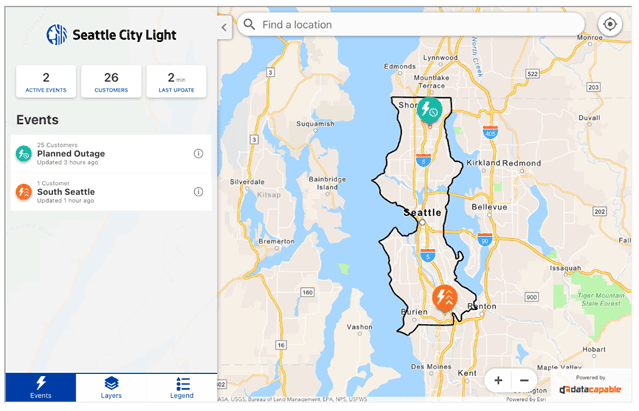
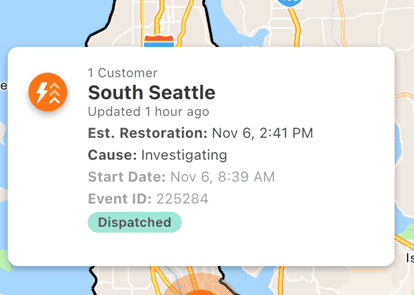
If you don’t see your outage on the map after about five minutes, it means we may not know about it yet, so please call (206) 684-3000 from the phone number associated with your account or have your account number ready to share. You can find your account number at the top of your bill (paper copy or email).
Areas in Downtown, First Hill, and University District that are served by an underground network do not connect to our outage map, so outages in those locations do not appear on the map.
Here’s how to make the outage map appear like an app on your home screen, so it’s easy to find when you need it:
- Open seattle.gov/poweroutage on your phone.
- iPhone: Depending on the model, tap the Share icon (a square with an up arrow) or the three dots in a line and then the Share button. You can find both icons near the website address bar. Then scroll down and click “Add to Home Screen.”
- Android: Tap the menu, then “Add to Home screen.”
2. Sign up for alerts that matter to you
There are two primary types of alerts from the City of Seattle or City Light related to storms, and each one has a different purpose.
Outage alerts: updates about your power
City Light is testing outage alerts by text and email. Right now, available technology allows us to send text and email alerts for smaller outages that affect fewer than 500 customers. You’ll receive these alerts if your online City Light account includes your mobile number or email and the outage impacts less than 500 people. Alerts usually arrive within 5 to 10 minutes after an outage begins, and you’ll get another alert when your power is back on. We plan to provide text and email alerts for larger outages in 2027.
To check or update your account contact information:
1. Log in to myutilities.seattle.gov.
2. Go to My Profile, then Notifications & Alerts.
3. Open Power Outage and choose text, email, or both. Updates can take up to 24 hours.
4. Save (888) 442-7594 and no-reply@seattle.gov to your contacts so you’ll recognize our alerts.
Areas in Downtown, First Hill, and University District that are served by an underground network do not connect to our alert system, so text and email alerts are not available in these areas.
Alert Seattle: city emergencies and severe weather
Unlike outage alerts, Alert Seattle doesn’t send updates about your power. Instead, it sends alerts to the public during emergencies. You can also choose to receive customizable community notifications for things like severe weather.
Choose your alert types at seattle.gov/alerts, or text SEATTLE to 67283.
3. Put together an outage kit
A few basic supplies can make any outage safer and more comfortable. Keep them together in one easy-to-find spot, like a bin or backpack near an exit.
- Drinking water
- Food that doesn’t need cooking, plus a manual can opener
- Flashlights and extra batteries (they’re safer than candles)
- Charged power banks and phone cables. Charge them when a storm is in the forecast
- A first-aid kit and a supply of prescription medicines
- Warm blankets and layers of clothing
- Some cash
- Pet supplies (food, water, crate)
- A battery-powered or hand-crank radio
- Thermometers for your fridge and freezer
Preparing for bigger emergencies? For events like an earthquake, the Seattle Office of Emergency Management recommends keeping 7 to 10 days of supplies on hand.
4. Make a plan that fits your family
Your plan should answer this question: what in your home requires power, and what will you do if the power goes out? Think about important items like medical equipment, refrigerated medicine, your sump pump, heat, etc.
Here are a few resources and some general guidance to consider:
Life Support Equipment program: If someone in your home requires life support equipment that needs power, consider enrolling in our Life Support Equipment program. The program offers personal notice of planned outages, and of unplanned outages likely to last more than eight hours, so you have time to arrange backup power.
- Plan for backup power: The program doesn’t provide backup power, so it’s important to work with your health care provider on a backup plan, such as a battery system.
How to enroll: Complete the application and have a licensed health care provider fill out the certification form. Renew every year.
Questions: Call (206) 684-3336 or email SCL_LifeSupport_Prg@seattle.gov.
Get ready when a storm is in the forecast: charge your phones and power banks, fill your gas tank or charge your electric vehicle, and bring in or secure outdoor items like patio furniture and trampolines so they stay clear of power lines in windy conditions.
Learn to open your garage door by hand. The manual release is usually a red cord hanging from the opener’s rail. It’s a lot easier to find when the lights are on, so we recommend locating it before there’s an outage and keeping a flashlight or headlamp in the garage. If you rent, start by checking with your landlord or building manager.
5. Know how to stay safe
- Stay clear of downed lines. Always treat a downed line as live. Stay at least 30 feet away (about the length of a school bus or two standard cars) and call 911. If a power line is on your car, stay inside until first responders say it’s safe to get out.
- Use generators outdoors only, more than 20 feet from windows, doors, and vents. View additional safety information on our dedicated generator webpage.
- Install carbon monoxide detectors with battery backup in central locations on every level of your home.
- Keep the fridge and freezer closed. Food stays safe for about four hours in a closed fridge and about 48 hours in a full freezer (Ready.gov). Food that has been above 40 degrees Fahrenheit for two hours or more should be thrown out. Check with a pharmacist about refrigerated medicine.
- Unplug electronics and leave one light on. Unplugging electronics protects them from a power surge when power comes back on, and the light lets you know when power is back.
- Give crews room to work. Stay back from work zones.
- Check in with neighbors, especially older adults and people who live alone.